Author Archives: Gordon Rogers

Salinity

Increased salinity in irrigation water, especially in times of drought, is a significant threat to the vegetable industry. The impact of drought on irrigation water quality can make it unsuitable for salt-sensitive crops.

The vegetable producing areas most at risk from increased salinity include:

  • Lockyer Valley, Bowen, Qld
  • Werribee, Vic, especially recycled water used for irrigation
  • Perth, Manjimup and Pemberton in WA
  • Virginia Plains and Murray Bridge in SA

Click HERE for a CSIRO review on the benefits and risks of using recycled water, including the issue of salinity.

Vegetable

EC tolerated
No effect on yield
(dS/m)
EC semi-tolerated
Yield reduced by 10%
(ds/m)
Zucchini 3.1 3.8
Garden beet 2.7 3.4
Broccoli 1.9 2.6
Cucumber 1.7 2.2
Tomato 1.7 1.9
Rockmelon 1.4 2.4
Watermelon 1.3
Spinach 1.3 2.2
Cabbage 1.2 1.9
Celery 1.2 2.2
Broad bean 1.1 1.8
Potato 1.1 1.7
Sweet potato 1.0 1.6
Capsicum 1.0 1.5
Sweet corn 1.0 1.7
Lettuce 0.9 1.4
Onion 0.8 1.2
Eggplant 0.7 1.6
Carrot 0.7 1.2
Beans 0.7 1.0
Radish 0.7 0.9
Turnip 0.6 1.3

Using irrigation to manage low and high temperature spikes

Irrigation can be used as a tool to manage temperature extremes in vegetable crops. Temperature stress is likely to occur either as:

  • High temperature spikes or heatwaves; or
  • Frosts.

Heatwaves

Overhead solid-set irrigation or hand-shift sprinkler irrigation can reduce the temperature of foliage, flowers or fruit during high temperature extremes. It would be possible to use travelling irrigators or centre pivots for the same use.

Growers could consider retaining the capacity for using sprinklers for temperature mitigation. In lettuce production for example, it is common practice to install both trickle- and solid-set sprinkler irrigation on the same crop. The solid set is used to keep the soil uniformly moist for good crop establishment, especially on direct-seeded crops. The trickle irrigation is then switched on for the main growing cycle to maximise water use efficiency and availability to the plant.

Frost control

Frosts can cause severe damage to vegetable crops. If the predicted increases in the variability of the climate occur, especially in the frequency of extreme hot and cold spells, then frost is likely to become a more important issue than is currently the case.

The potential economic impact of frost is much higher than changes in average temperatures might seem to suggest. Average temperature changes will be gradual and there will be time to change species or varieties, or even move to new regions over time if required. However a severe frost can have a devastating effect on the profitability of a farming operation.

The extent of this potential loss depends on the length of the growing season. Short season (4-8 weeks) crops such as lettuce and other leafy salad vegetables are least likely to be affected. Longer-term crops such as brassicas, carrots, beetroot and sweet corn are more likely to be affected, although the most frost-sensitive stages are usually in the germination and establishment phases.

Vegetable growers are in a strong position in relation to managing frost because they can irrigate crops, especially with overhead sprinklers, which is a powerful tool in minimising frost damage.
Temperature, variety and CO2 can interact

Example of interactions in babyleaf spinach

Some recent research on baby-leaf spinach shows a very interesting interaction between CO2, concentration and growing temperature.

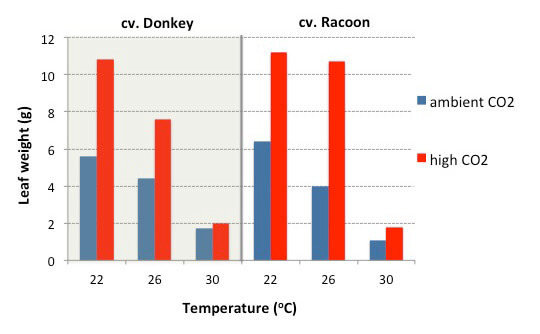
Two baby-leaf spinach varieties, Donkey (slow growing) and Racoon (fast growing), were grown at two CO2 concentrations, 400 ppm (ambient) and 640 ppm (high), over three temperature regimes, 22, 26 and 30oC. Both varieties grew best at 22oC and progressively worse at 26 and 30oC.

The higher CO2 concentration had a significant positive impact on growth at the two lower temperatures. In the faster-growing variety – Racoon – the elevated CO2 counteracted the adverse effect of higher temperature on growth at 26oC but was not able to do the same at 30oC.

This type of study shows the critical impact of temperature on the growth of cool-season leafy crops such as spinach and the complicated interactions that occur between variety type and the direct effects of higher CO2 levels.

CO2 temp interaction baby spinachSource : J. Conroy.