Protected cropping accounts for a significant slice of the vegetable and flower industries in Australia, with a current annual GVP of about $1.3 billion (Graeme Smith Consulting) or about 16% of the total GVP for horticulture of $8.4 billion (ABS). There are about 1,300 ha of greenhouses in Australia with an average infrastructure value of $75/m2.
The industry is currently expanding at a rate of a rate of 25 ha of new structures per year with the cost of building new structures valued at $200/m2 or at ($50 million) per year.
Types of structures
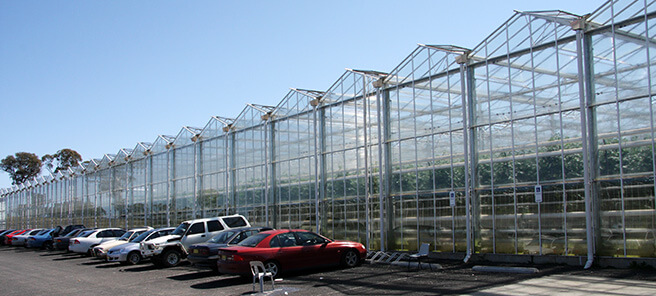
There are three broad classes of protected cropping generally referred to by industry as low tech, medium tech and high tech.
- Low structures are usually plastic covered igloos with minimal ventilation and heating .
- Medium tech structures are more sophisticated, with computerised ventilation systems, heating and growing systems. The structures themselves are large multi span buildings with automated ventilation and shading systems but the coverings are usually a form of plastic.
- High tech structures are the most sophisticated growing systems available with advanced computer-controlled heating and cooling systems, CO2 enrichment, large conglomerate structures covering large areas, up to 25ha in Australia. The covering material is usually glass.
Productivity
The yield potential from protected cropping is much higher than is possible to achieve from normal outdoor production, with potential improvements ranging from 250 to 800%
Average yields from protected cropping compared to field production
| Crop |
Field
(kg/m²) |
Greenhouse
(kg/m²) |
Increase
(%) |
| Tomatoes |
18 |
76 |
422 |
| Capsicums |
12 |
30 |
250 |
| Cucumbers |
20 |
100 |
500 |
| Lettuce |
10 |
80 |
800 |
These yield differences also depend on the sophistication of the greenhouse system
Relative yields from low, medium and high tech protected cropping
Yield
(kg/m2/year) |
Low
technology |
Medium
technology |
High
technology |
| Tomatoes |
25 – 35 |
35 – 55 |
65 – 105 |
| Capsicums |
15 – 20 |
20 – 25 |
30 – 33 |
| Cucumbers |
60 |
88 |
120 |
| Lettuce |
30 |
60 |
90 |
Protected cropping to mitigate climate change
The protected-cropping industry is likely to be least affected by the physical impacts of climate change and increased climate variability and as such it may be a very useful adaptation strategy to allow production to continue, especially in areas close to retail markets. Temperature can be regulated to a large extent, and heating of greenhouses located in cool regions is becoming more energy- and emissions-efficient all the time.
Protected cropping and associated hydroponic irrigations systems are very efficient users of water. Fruit and vegetable growing generally uses about 38L of water per dollar of value produced, whereas hydroponically-produced vegetable crops use only 0.6L of water to produce the same value.
The main concern with greenhouse production is the cost as well as energy that is consumed in construction, maintenance and production of the crops. Structures tend to have:
- High energy-use for heating and cooling.
- High energy-inputs into the construction of greenhouses and in the manufacture of materials.