Tag Archives: estimating emissions

An assessment of greenhouse gas emissions from the Australian vegetables industry

Recently, partly due to the increasing carbon consciousness in the electorates and partly due to the imminent introduction of the Australian Government’s Carbon Pollution Reduction Scheme (CPRS), estimating carbon footprints is becoming increasingly necessary in agriculture. By taking data from several sources, this study estimates the national greenhouse gas (GHG) emissions from
a variety of farm inputs, for the 23 key vegetables crops grown in Australia. For the 121,122 ha of land occupied by vegetable farms, there are 1.1 MtCO2e GHG emissions or 9.2 tCO2eha−1.

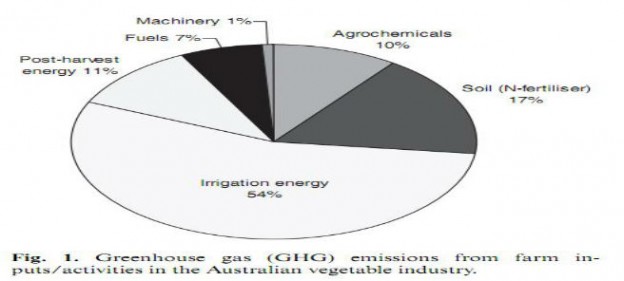
  • 65 % of total GHG emissions from the vegetable industry are due to electricity use for irrigation and post-harvest on-farm activities,
  • 17 % from soil N2O emissions due to N fertiliser use,
  • 10 % from agrochemicals,
  • 7 % through fossils fuels and
  • 1 % from on-farm machinery.

The top four vegetables, potatoes, lettuce, tomatoes and broccoli account for 29.1 %, 7.9 %, 5.9 % and 7.2 % of total GHG emissions from vegetables, respectively. However, the ratio of GHG emissions between the highest and lowest-emitting crops per hectare and per tonne, are different. Therefore, care must be exercised in carbon footprint labeling vegetable products to ensure that the labels reflect carbon emissions on a per tonnage basis.
Click here for the full article.

Understanding and managing impacts of climate change and variability on vegetable industry productivity and profits

The Australian vegetable industry is in a strong position to deal effectively with climate  change. The industry has excellent climate change credentials, is a low emitter of
greenhouse gasses on a productivity basis, and has one of the lowest carbon and water
footprints of any food producer. Vegetable growers also have greater capacity to adapt to
change than most other rural industries.

The threats, however, are serious, and the industry should not be complacent. The viability
of vegetable production can be affected either by the physical impacts of a changing
climate, or by government policies aimed at addressing climate issues. This review has
focused on identifying actions growers and the industry can take in the short and longer
term to safeguard the Australian vegetable industry against climate related threats.
Industry and farm managers will need to distinguish between ‘old climate expectations’ and
‘new climate realities’ in determining how best to adapt vegetable farming to our more
variable climate and where possible, further reduce our greenhouse gas emissions.

The challenge for the industry is to develop a clear strategy for how best to adapt to
anticipated climatic and atmospheric changes, in ways that minimise adverse financial and
environmental impacts and take best advantage of any positive changes. This review will
build on previous climate change studies conducted for the horticulture industry.

Click here for the full report

Who will use the vegetable carbon tool?

The question of ‘Who will use the vegetable carbon tool?’ will only be properly answered
after a better understanding of all the discussion papers from this series is also available. This is because there are many “levels” at which a carbon footprint can be measured.

Although the reasons for reporting, accounting or reducing GHG emissions will vary
considerably from individual growers through to Industries and industry sectors, any
business or industry that has a requirement (legal or otherwise), to report or account for
GHG emissions, will require access to a mechanism or a tool to estimate or measure, their
GHG emissions.

Click here for the full report