Tag Archives: carbon footprint

An assessment of greenhouse gas emissions from the Australian vegetables industry

Recently, partly due to the increasing carbon consciousness in the electorates and partly due to the imminent introduction of the Australian Government’s Carbon Pollution Reduction Scheme (CPRS), estimating carbon footprints is becoming increasingly necessary in agriculture. By taking data from several sources, this study estimates the national greenhouse gas (GHG) emissions from
a variety of farm inputs, for the 23 key vegetables crops grown in Australia. For the 121,122 ha of land occupied by vegetable farms, there are 1.1 MtCO2e GHG emissions or 9.2 tCO2eha−1.

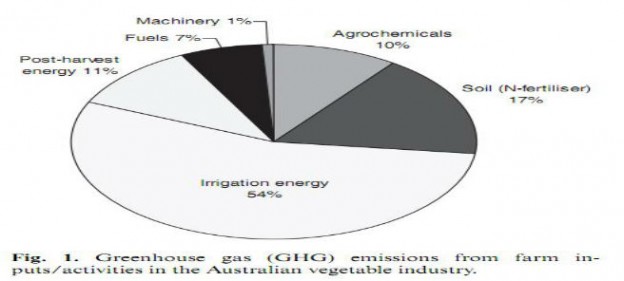
  • 65 % of total GHG emissions from the vegetable industry are due to electricity use for irrigation and post-harvest on-farm activities,
  • 17 % from soil N2O emissions due to N fertiliser use,
  • 10 % from agrochemicals,
  • 7 % through fossils fuels and
  • 1 % from on-farm machinery.

The top four vegetables, potatoes, lettuce, tomatoes and broccoli account for 29.1 %, 7.9 %, 5.9 % and 7.2 % of total GHG emissions from vegetables, respectively. However, the ratio of GHG emissions between the highest and lowest-emitting crops per hectare and per tonne, are different. Therefore, care must be exercised in carbon footprint labeling vegetable products to ensure that the labels reflect carbon emissions on a per tonnage basis.
Click here for the full article.

Options for mitigating greenhouse gas emissions for the Australian vegetable industry

This report discusses the future opportunities for the Australian vegetable industry to
reduce its carbon footprint. It has been written as part of a series of six discussion
papers for a workshop that will set future directions for R, D & E on greenhouse gas
emissions from the vegetable industry.
Currently there are efforts to quantify the carbon footprint of the vegetable industry,
however the focus must also turn to identifying actions available to minimises
greenhouse gas (GHG) emissions and reduce the carbon footprint of the vegetable
industry.
The aim of this report is to i) identify practical methods by which Australian
vegetable growers can manipulate and minimise their carbon footprint and ii) identify
potential R, D & E needs required before vegetable growers can implement these
changes.

Click here for the full report

Who will use the vegetable carbon tool?

The question of ‘Who will use the vegetable carbon tool?’ will only be properly answered
after a better understanding of all the discussion papers from this series is also available. This is because there are many “levels” at which a carbon footprint can be measured.

Although the reasons for reporting, accounting or reducing GHG emissions will vary
considerably from individual growers through to Industries and industry sectors, any
business or industry that has a requirement (legal or otherwise), to report or account for
GHG emissions, will require access to a mechanism or a tool to estimate or measure, their
GHG emissions.

Click here for the full report