Tag Archives: estimating emissions

The Land Sector in the National Inventory

This document provides an overview of how emissions are estimated from the land sector (extending over 106 million hectares) to determine for Australia’s national inventory report. The design of this system relies heavily on the application of satellite data to assess land use change and the use of a modelling framework to estimate the biomass of vegetation on lands across Australia, the carbon stored in above and below ground vegetation and soil and emissions resulting from land use and management activities.
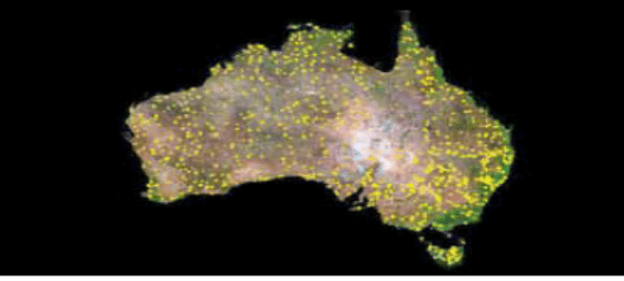
Click here for the full article

Australia’s National Inventory Report 2010

This is Australia’s National Inventory Report 2010, submitted under the United Nations Framework
Convention on Climate Change (UNFCCC) and the Kyoto Protocol (KP). The National Inventory Report provides estimates of Australia’s total net emissions in 2010 and identifies trends in emissions between 1990 and 2010 for each of the sectors and for the main greenhouse gases. It also provides comprehensive information on estimation methodologies and data quality; details of recalculations of emissions estimates and background on the national system and the inventory preparation processes in order to facilitate international review and comparisons with the inventories of other countries. This report is submitted to the UNFCCC to fulfill Australia’s reporting obligations under the Convention.

Click here for the full report

Greenhouse gas emissions from the agriculture sector

This report provides updated projections of key agricultural activity levels which when applied to the Department of Climate Change and Energy Efficiency (DCCEE) emissions spreadsheets give projections of agricultural greenhouse gas emissions in each year from 2009 to 2030.

It provides an update to previous projection rounds taken by the Centre for International Economics (CIE) for the then Australian Greenhouse Office (AGO) and DCCEE in 2003, 2005, 2007 and 2008. Like previous rounds, this report uses three economic models of Australian agriculture:

  • The Global Meat Industries (GMI) model;
  • The CIE Grain model; and
  • The CIE Dairy model.

Click here for the full report.